The yard scanner, the gate reader and ‘the arch’ were one device. Two extractions from the same seven utterances did not agree. Both passed every check.
The engineer called it the yard scanner. It was a Zebra FX9600 at the gate, reading the tags on every pallet that left. The owner called it the gate reader. Some of the warehouse crew called it “the arch.” The interview made one point unusually clear: all three names meant the same device.
I used that seven-utterance interview to test a system I had built in an afternoon. I had records, nodes, edges, a vector index and a query that returned a plausible answer. Then I ran the interview through extraction twice.
The two runs disagreed seven times across three records. Two claims were phrased differently, and each run found claims the other missed. One split an idea that the other kept whole. One created a record and a link that did not exist in the other run. The most serious difference was smaller: one thing had entered under two names.
Both versions conformed to the same registry, and each was internally consistent. Every check was green.
I am building something I will call the record: a system that interviews people, checks claims against their sources and answers questions about what it has learned. Models help extract claims, search for evidence and judge whether a source supports them. They never directly write the answer that a reader sees. Every printed value comes from a deterministic resolver reading recorded frontmatter.
That separation was meant to make the answers dependable. The double extraction showed what it could not do. Either record set would travel through the rest of the system cleanly, even though each described the conversation differently. Determinism could preserve a mistake as faithfully as it preserved a fact.
What the checks never asked
Graphs are generous. Give one a legal node, edge or property and it will store it. It does not know that two identifiers name the same thing, that five sources copied one another, or that a new claim inherited an old date. Those are facts about the world outside the graph.
My checks knew the registry and rejected unknown predicates, malformed evidence, illegal relationships and contradictory live claims in the same slot. They could tell whether a record had a valid shape. The extraction experiment asked a different question: did that shape still refer to the world it came from?
The answer was unknowable from either graph alone. The convergence tool could report that the two runs differed, but it could not pick the right one. That choice requires knowledge of the domain or another source, so it belongs to a person.
This became the test for every failure that followed. I looked at what had passed, what was still wrong, and which decision the machinery had quietly made without authority.
One thing entered twice
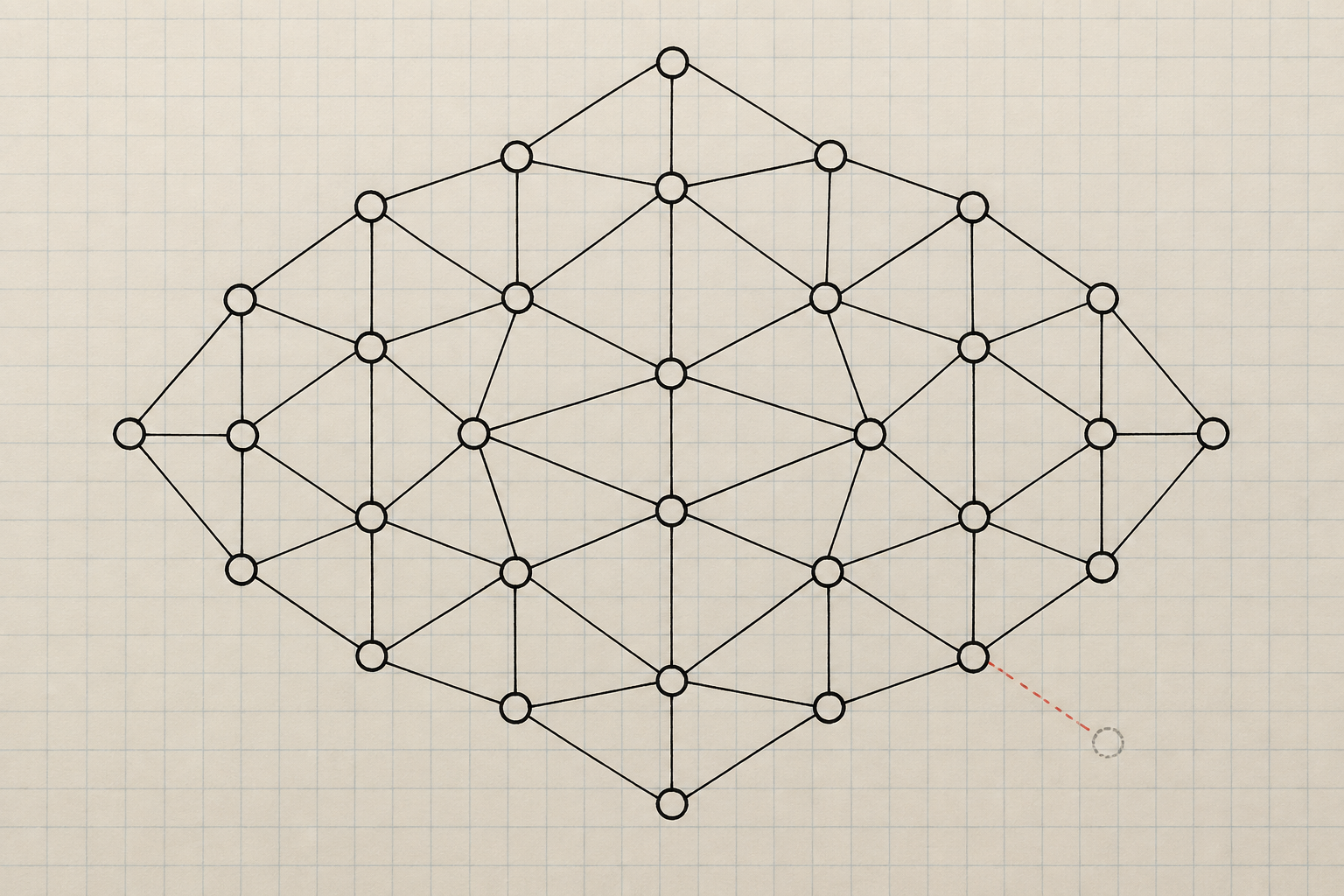
A duplicate node is a peculiar failure because nothing has to break. Search for either version and the result looks reasonable. Traverse from either and its neighbours make sense. The corpus is simply wrong about how many things exist.
The extraction literature calls this canonicalisation. An open knowledge base does not inherently know that “Barack Obama” and “Obama” refer to one person, so it can store both as separate entities [6]. Newer methods improve the clustering on some datasets and tie older methods on others [7]. Those results measure how well names are grouped. They do not establish that the resulting answers improve.
Production systems make different bets. One graph-memory method tells its resolution prompt that duplicates can have different names [8]. Microsoft’s GraphRAG merges entities with the same title and type, and its paper describes exact string matching [9] [4]. The Mem0 paper describes matching nodes by embedding similarity [22], while its current open-source documentation describes a content hash for exact duplicates and says graph memory was removed from that edition [23]. Exact strings can miss aliases, while similarity can join two different things; either error can remain invisible.
Medicine and biology gave me a better model. The UMLS Metathesaurus is organized around concepts and links the many names used for one meaning across almost two hundred vocabularies [10]. SNOMED CT keeps a stable concept separate from its full name, preferred term and synonyms; the preferred term can vary by language [11]. The Gene Ontology goes further and types a synonym as exact, broad, narrow or related [12].
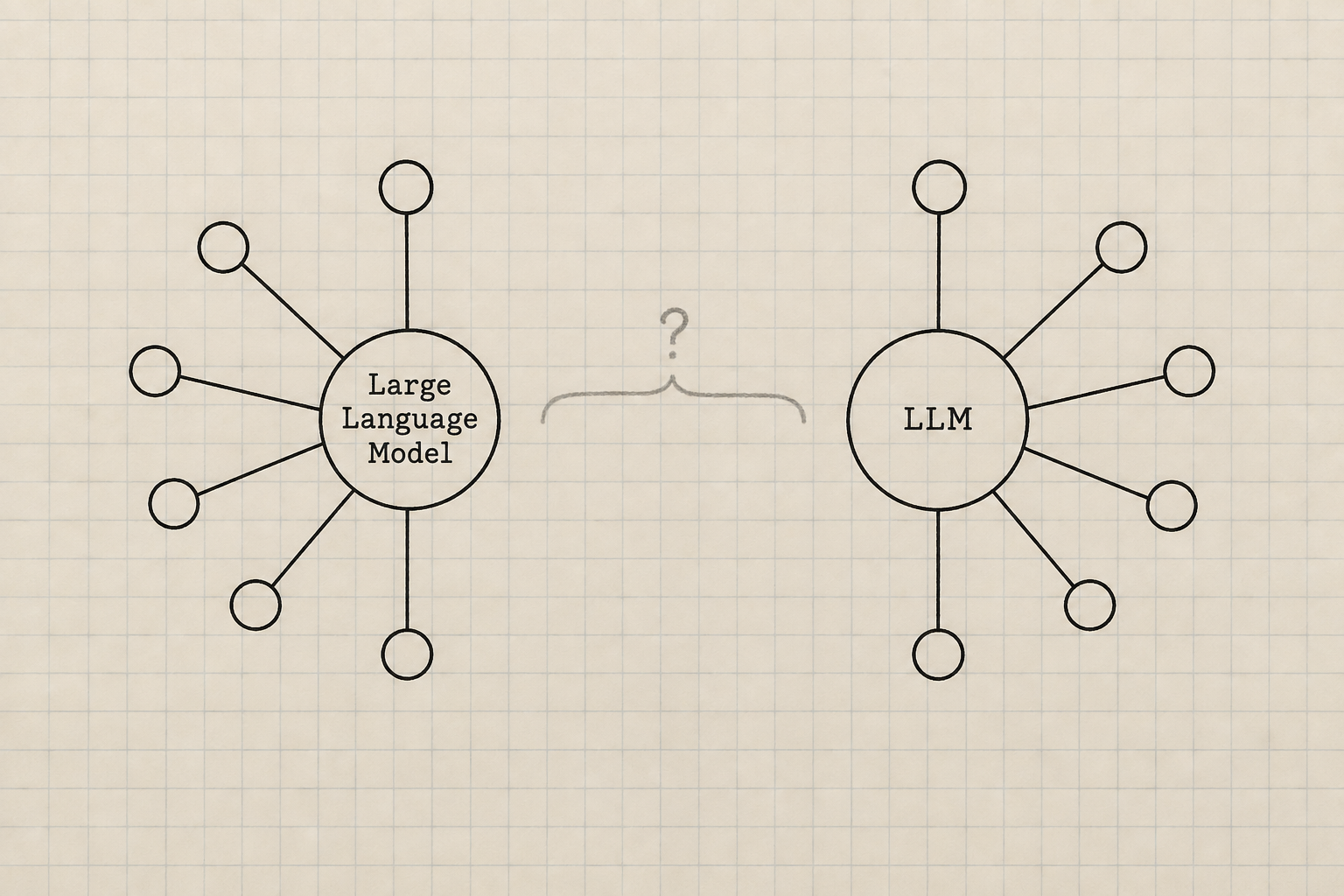
The useful distinction is simple: a concept has an identity; a name is one way people refer to it. The modelling is mature, but automatic resolution remains uncertain.
I took the conservative route. Before a new concept is created, a lexical check compares its name, aliases and summary with the concepts already in the record. An exact alias is always proposed as a match; overlapping names or summaries can raise another candidate. The check warns without blocking or merging. A person makes and records the decision.
Fellegi and Sunter called this the “possible link” class in their 1969 theory of record linkage [13]. My check is only a tripwire for that state. It can still miss two synonyms with no lexical overlap, including “yard scanner” and “gate reader” if their summaries do not reveal the connection. The uncertainty is visible, but entity resolution remains unfinished.
The detector I deleted
Identity failed again when I made the schema more expressive.
A subject originally held one live claim for each predicate. I needed the same subject
to carry several facets of a predicate, so I added an aspect value inside its scope.
The first change took about an hour to implement. Records that had collided before
could now coexist under different aspect values, exactly as intended.
One of those collisions had been doing extra work. Two unrelated rules had landed in one record. With no aspect to separate them, the uniqueness constraint rejected the pair as an undeclared contradiction. That rejection was the only signal that the record might contain two concepts. Once each rule had its own aspect, both validated.
Everything was still green.
I left a note on the constraint because its second job was easy to miss:
An aspect key buys the ability to hold several facets of one subject and pays for it by switching off the signal that the subject was overloaded.
A constraint can enforce the rule you designed and expose a modelling error you never named. The second service is fragile because nobody owns it. Add a discriminator and the collision disappears; months later, the cost can be a corpus of concepts split or combined in ways no query can detect.
I kept the scope field, closed the list of allowed aspect values and added a separate check that compares claims across them. The original constraint had provided both behaviours for free. Making them explicit cost more code, but it also gave each one a name and an owner.
Ninety seconds became two days
The next failure appeared in the sentence a person actually reads.
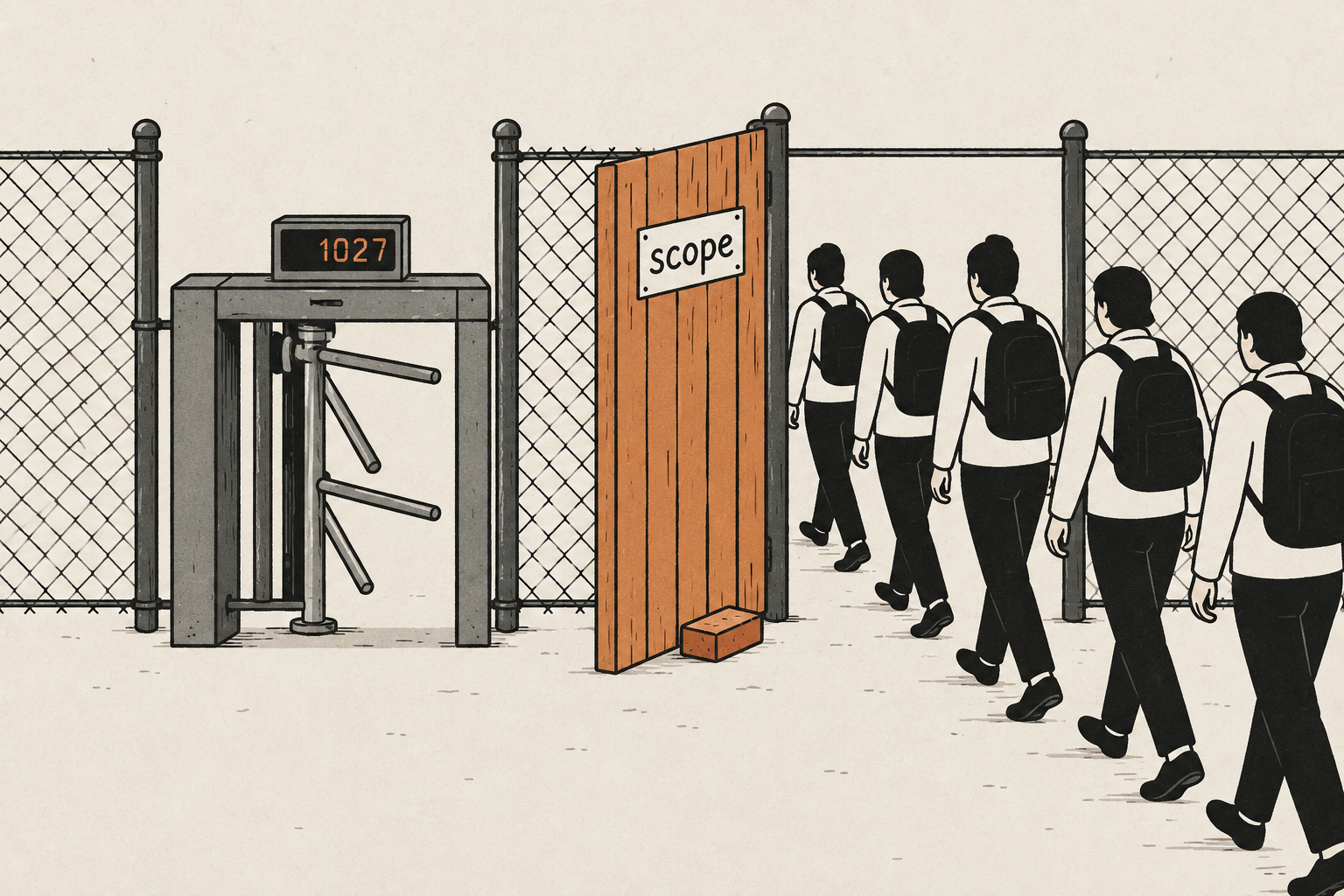
I recorded a decision that superseded an older claim in the same slot. Ninety seconds later, I asked the record about it. The answer contained the new claim’s text followed by “Recorded 2 days ago.” The trace view showed the right claim and the right time.
The resolver had selected the new assertion. The display then took the recording date from the first assertion in the slot, which was the one just superseded. The stored data was sound and the resolution was sound. The answer made fresh knowledge look stale, which is how useful information gets ignored.
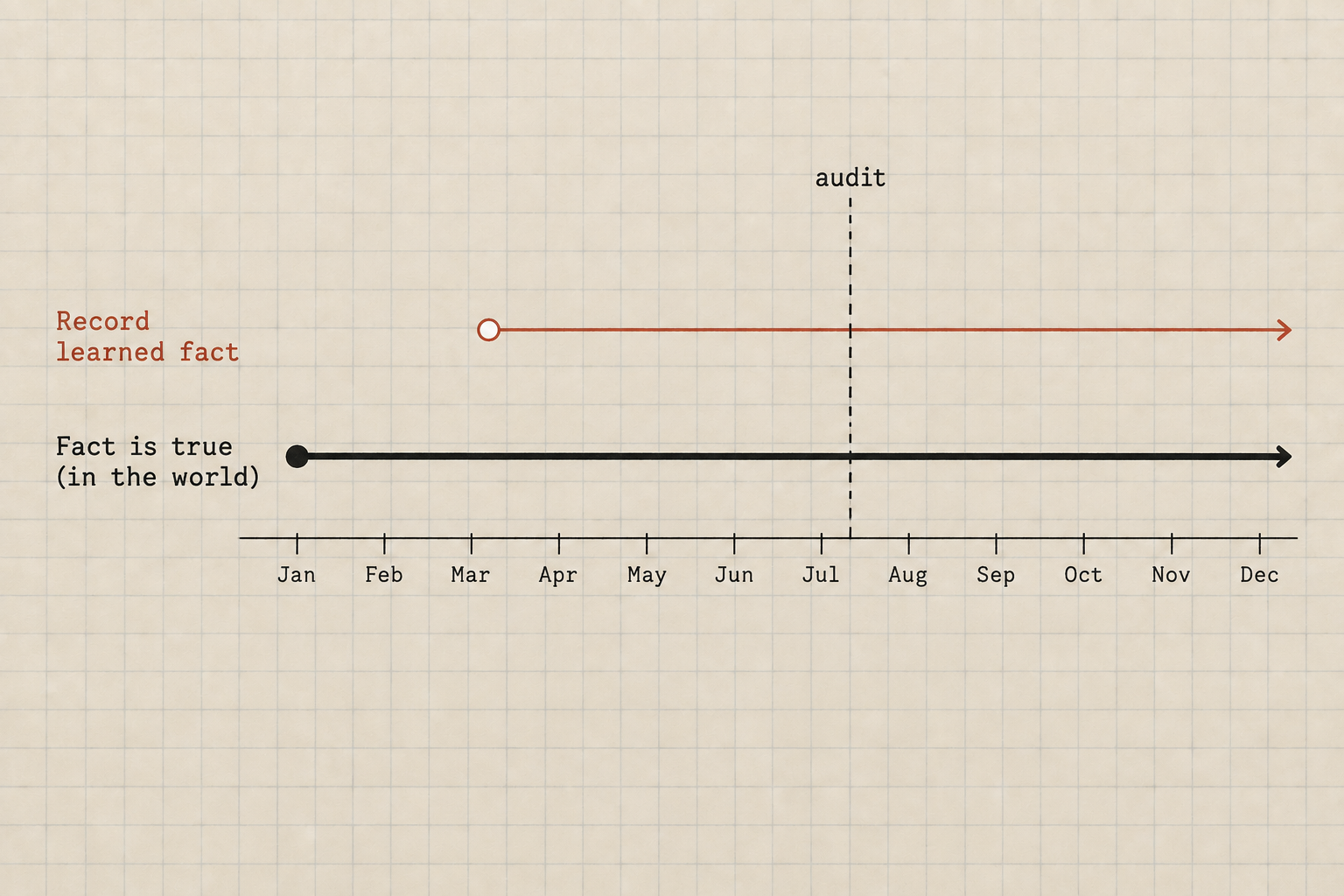
Temporal database researchers distinguish two clocks. Valid time says when a fact holds in the world. Transaction time says when the database learned or recorded it [14]. A tariff can take effect in January and reach the record in March. An auditor may later ask what the system believed in February about the January tariff. One timestamp cannot answer that question.
Bitemporal databases preserve the distinction during deletion as well. XTDB closes the old version’s system-time interval so earlier versions remain available [15]. Datomic records a retraction where an ordinary database might remove data [16]. The past remains addressable because closing an interval preserves the record.
My conformance gate did not catch the display bug. It ran the new implementation beside its reference and required identical output. The reference contained the same faulty line, so the two implementations agreed byte for byte. Everything was still green. A check for divergence cannot expose a defect shared by both sides.
The answer now takes recorded_at from the assertion the resolver returned. Every
transaction timestamp comes from the system clock. Valid time remains a separate claim
about the world and comes from evidence about when the claim held.
Five witnesses, one source
Agreement looked safer until I followed the edges back.
A graph can show five sources supporting one claim. If four copied the fifth, there is one observation with five URLs. Counting the edges turns repetition into apparent corroboration.
Researchers modelled source dependence as early as 2009. A false value can spread through copying, after which agreement offers much less evidence [19]. The resolver therefore counts independent sources behind the support. Repeated claims or links do not increase that count.
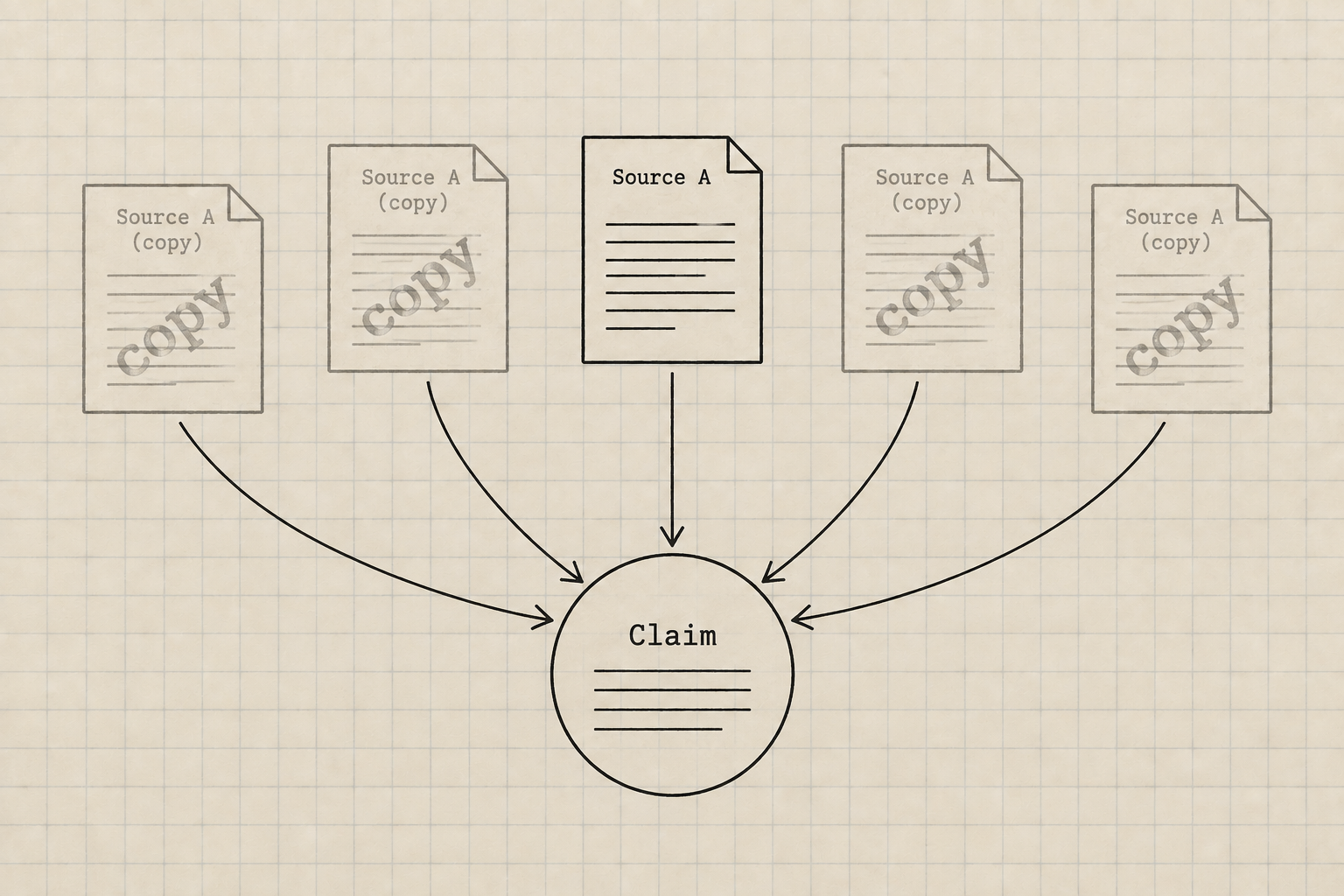
The same issue becomes harder when sources truly disagree. A last-write-wins rule discards an assertion when a replacement arrives. Averaging creates a value that nobody supplied. A confidence score in the interface appears more careful. In one evaluation, two established truth-discovery methods produced a false positive rate of 1.0 on both datasets; they predicted every value true [17].
I made contradiction a state in the record. A slot contains one resolved claim or an
explicit UNKNOWN_CONTRADICTED result with the competing values attached. The
intelligence community’s analytic standards require analysts to consider contrary
information and expose significant differences in judgement to the reader
[18].
This matters before an attacker appears, but an attacker makes the cost plain. One retrieval-poisoning study achieved a 90 percent attack success rate with five malicious texts per target question in a database of millions [21]. A fetched page, an interview claim and a schema decision enter with different authority. If they become interchangeable nodes, that distinction has already been lost.
The node that was never created
Some failures remain outside every improved constraint.
I built an evaluation view that placed each answer beside all the records relevant to its question. On the first reading, it found an answer that was sourced, stable and silent on one third of what had been asked. The question requested what had been answered or dropped since an earlier point. The response reported only the current state. Nothing in it was false. A needed part was absent, and every mechanical check passed.
I can query for claims marked unverified, contradicted or stale. I cannot query for a node that was never created. Knowledge-base researchers describe completeness as a property of a particular question because no practical knowledge base can equal the whole truth [20].
That means a coverage measure needs an expected set from outside the graph. Without that denominator, the system is comparing what it found with what it found. A high percentage says nothing about the missing third.
The boundary I stopped trying to erase
The failures began to make sense when I gave the graph less authority.
The canonical record now lives in plain files. Claims retain their evidence, review state, valid interval and recording time. A changed claim becomes a new assertion linked to the old one. Preservation systems have used this object-and-relationship model for decades [1].
The record can also retain a claim that has not been verified. It labels the evidence as unchecked or unverified and tells the reader. The refusal is narrower and more useful than deletion: an untested claim cannot quietly acquire the standing of a fact.
The graph is a projection of those files. It can be discarded and rebuilt, one partition at a time. When a claim is retired, rebuilding removes its projected edge without rewriting the historical record.
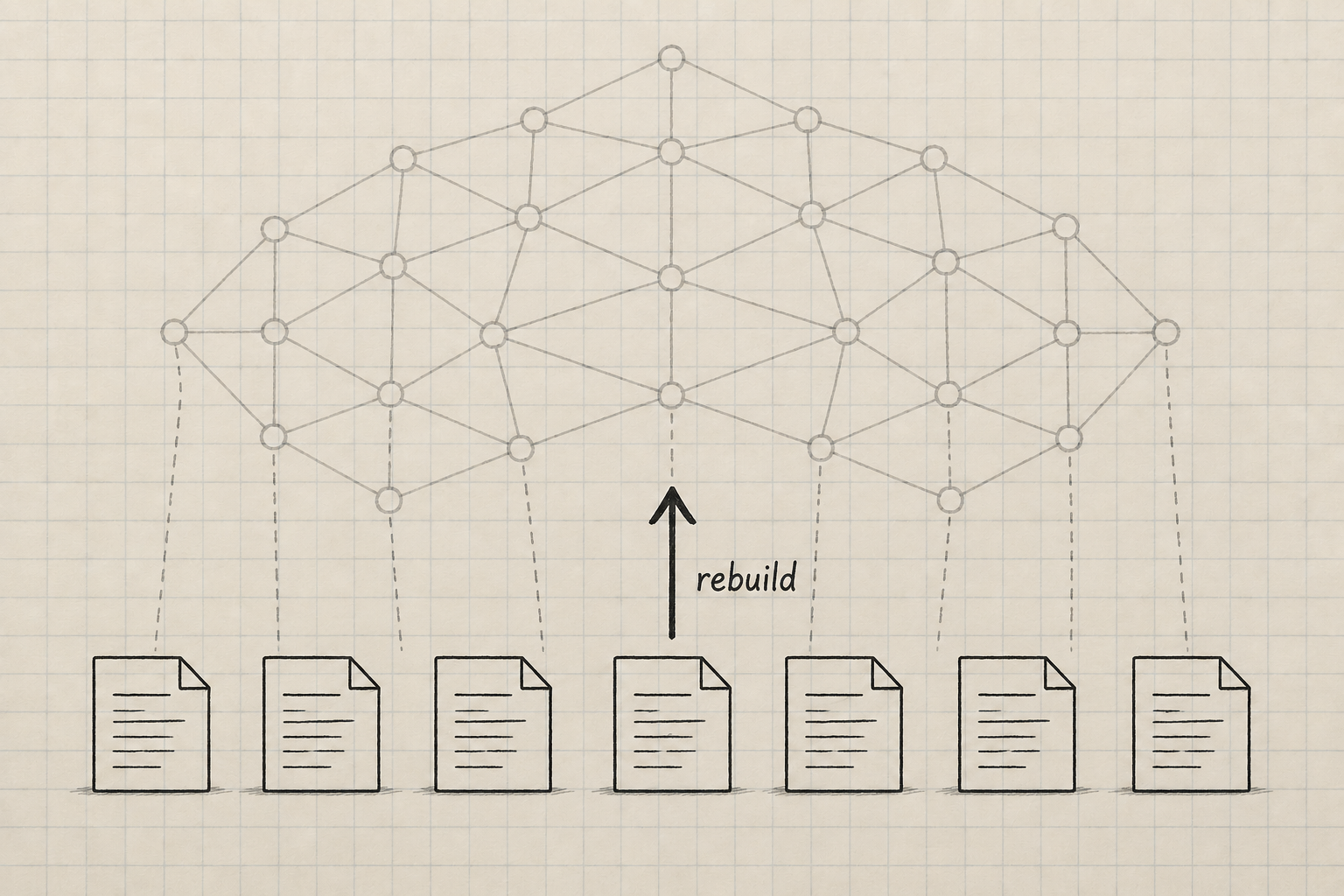
The boundary continues through the answer path. The index returns record keys to the resolver, which reads the records and selects the live claims according to their evidence and time. Once the same keys have been selected, its output is byte-identical whether the graph is available or stopped. The index can change which records are found; it cannot change what a selected record says.
That narrower job for the graph also changed retrieval. I had planned to begin every search by walking the graph. Published results argued against making that the universal default. On LoCoMo, a benchmark for memory over long conversations, graph-first systems scored about 55–56 percent accuracy while ordinary retrieval, Mem0 and full-context approaches scored 77–81 percent [2]. The authors of HippoRAG 2 likewise report that earlier graph approaches fall below standard RAG on basic factual memory [3].
Graphs earn their place on a different class of question. GraphRAG’s strongest results concern global questions about a corpus, evaluated for breadth and diversity [4]. I now classify questions as precise, multi-hop or global. Plain retrieval starts all three classes in the current design. Graph traversal can contribute to the last two, and the ranked lists are combined with reciprocal rank fusion. That method needs no training, and its original evaluation found that the exact constant was not critical [5].
The boundaries are deliberately plain. Extraction proposes claims, and evidence supports them. A person decides ambiguous identity after reviewing the evidence. The resolver handles time and authority, the graph finds paths, and the interface renders the chosen claim. Each part can be tested against the kind of fact it is capable of knowing.
What green means now
The convergence tool still will not turn the two versions of that seven-utterance interview into one. It reports the divergences, names the case where one thing received two identifiers, and declines to say which extraction was right. That last step remains a domain decision.
A green result now means that the records have a legal shape, their evidence can be traced, and the system kept contradictions visible and decisions inside their authority. Completeness still has to be measured for each question. Repetition still needs provenance, and an unreviewed claim remains unconfirmed.
The graph took an afternoon. Teaching the surrounding system where to stop took two weeks.
A graph will let you say more than you know. The work is in not saying it.
Sources
- Library of Congress. PREMIS Data Dictionary for Preservation Metadata, v3.0.
- Wolff & Bennati. Cost and Accuracy of Long-Term Memory in Distributed Multi-Agent Systems Based on Large Language Models, 2026.
- Gutiérrez et al. From RAG to Memory: Non-Parametric Continual Learning for Large Language Models (HippoRAG 2), 2025.
- Edge et al. From Local to Global: A Graph RAG Approach to Query-Focused Summarization, 2024.
- Cormack, Clarke & Büttcher. Reciprocal Rank Fusion Outperforms Condorcet and Individual Rank Learning Methods, SIGIR 2009.
- Vashishth, Jain & Talukdar. CESI: Canonicalizing Open Knowledge Bases using Embeddings and Side Information, WWW 2018.
- Dash et al. Open Knowledge Graphs Canonicalization using Variational Autoencoders, EMNLP 2021.
- Rasmussen et al. Zep: A Temporal Knowledge Graph Architecture for Agent Memory, 2025.
- Microsoft. GraphRAG indexing dataflow.
- National Library of Medicine. UMLS Metathesaurus.
- SNOMED International. SNOMED CT Editorial Guide: preferred term and synonym.
- Gene Ontology Consortium. Ontology documentation: synonym scopes.
- Fellegi & Sunter. A Theory for Record Linkage, JASA 1969.
- Jensen & Snodgrass. Temporal Data Management, IEEE TKDE 1999.
- XTDB. Time in XTDB: bitemporality.
- Datomic. Overview: retractions as facts.
- Zhao et al. A Bayesian Approach to Discovering Truth from Conflicting Sources for Data Integration, VLDB 2012.
- ODNI. Intelligence Community Directive 203: Analytic Standards.
- Dong, Berti-Équille & Srivastava. Integrating Conflicting Data: The Role of Source Dependence, VLDB 2009.
- Razniewski, Suchanek & Nutt. But What Do We Actually Know?, AKBC 2016.
- Zou et al. PoisonedRAG: Knowledge Corruption Attacks to Retrieval-Augmented Generation of Large Language Models, 2024.
- Chhikara et al. Mem0: Building Production-Ready AI Agents with Scalable Long-Term Memory, 2025.
- Mem0. Open Source: Migrating to the New Memory Algorithm.
Every source above was fetched and read at its origin during this work. Each cited sentence was checked against the page itself. Claims from blocked sources were omitted.